
Sungei Buloh Wetland Reserve is a free, easy-walking morning out with children, and the year-end school holidays fall inside its migratory bird season, which NParks gives as August to April. The reserve at Kranji opens 7am to 7pm (last entry 6.30pm), and every trail NParks grades is rated easy, from 150m to 3km.
Check one thing before you pick a date. NParks has published high-tide closures for parts of the reserve on 25 and 26 November and on 25, 26 and 27 December 2026, plus four dates between 27 November and 28 December when some areas may flood and may close (a fifth date, 28 October, has passed). Below: trails by age, the free walks, a spotting list and a half-day plan. More ideas are in our days out topic.
At a glance
- Hours and cost: 7am to 7pm, last entry 6.30pm, says NParks' Sungei Buloh page; NParks' trail and birdwatching pages say the walks and NParks' guided tours are free of charge.
- Migratory season: August to April, when Whimbrels, Common Greenshanks, Common Redshanks and Pacific Golden Plovers stop over on the mudflats.
- Closed for high tide: some areas on 25 November (10am to 12pm), 26 November (11am to 1pm), 25 December (10am to 1pm), 26 December (11am to 2pm) and 27 December (12pm to 3pm), per NParks' closure notice.
- May flood or close: 27 November (11am to 2pm), 28 November (12pm to 3pm), 24 December (10am to 12pm) and 28 December (1pm to 3pm), per its flood-risk notice; the notice's first date, 28 October (11am to 1pm), has passed, and no new dates had been added when we reopened it on 16 November.
- Dragonfly Pod: closed for maintenance from 4 November to 31 December 2026, says the notice on NParks' Sungei Buloh page.
- School holidays: MOE's 2026 school calendar puts the year-end vacation from Saturday 21 November to Thursday 31 December.
Is Sungei Buloh good for young children?
For most ages, yes, with two cautions. Every trail NParks grades on its trails and tours page is rated easy, and the Coastal Trail is described as "perfect for families and schools". The reserve is listed as wheelchair accessible; no page we read mentions strollers.
The cautions: this is a nature reserve with Estuarine Crocodiles, monitor lizards and otters, not a park with a playground, and NParks asks visitors not to jog, cycle, skate or use scooters or personal mobility devices inside. A child who needs to run may do better at a nature playgarden first.
Which trail suits which age?
Lengths are NParks'; the age fit is ours.
- Toddlers: Junior Wetland, then the Forest Trail. The Junior Wetland is a rehabilitated freshwater pond near the Visitor Centre with stone steps for a closer look at dragonflies, fish and the White-breasted Waterhen; NParks says children below 13 must be supervised by adults there. The Forest Trail is 300m and leads to the 150m Mid-canopy Walk, an elevated boardwalk.
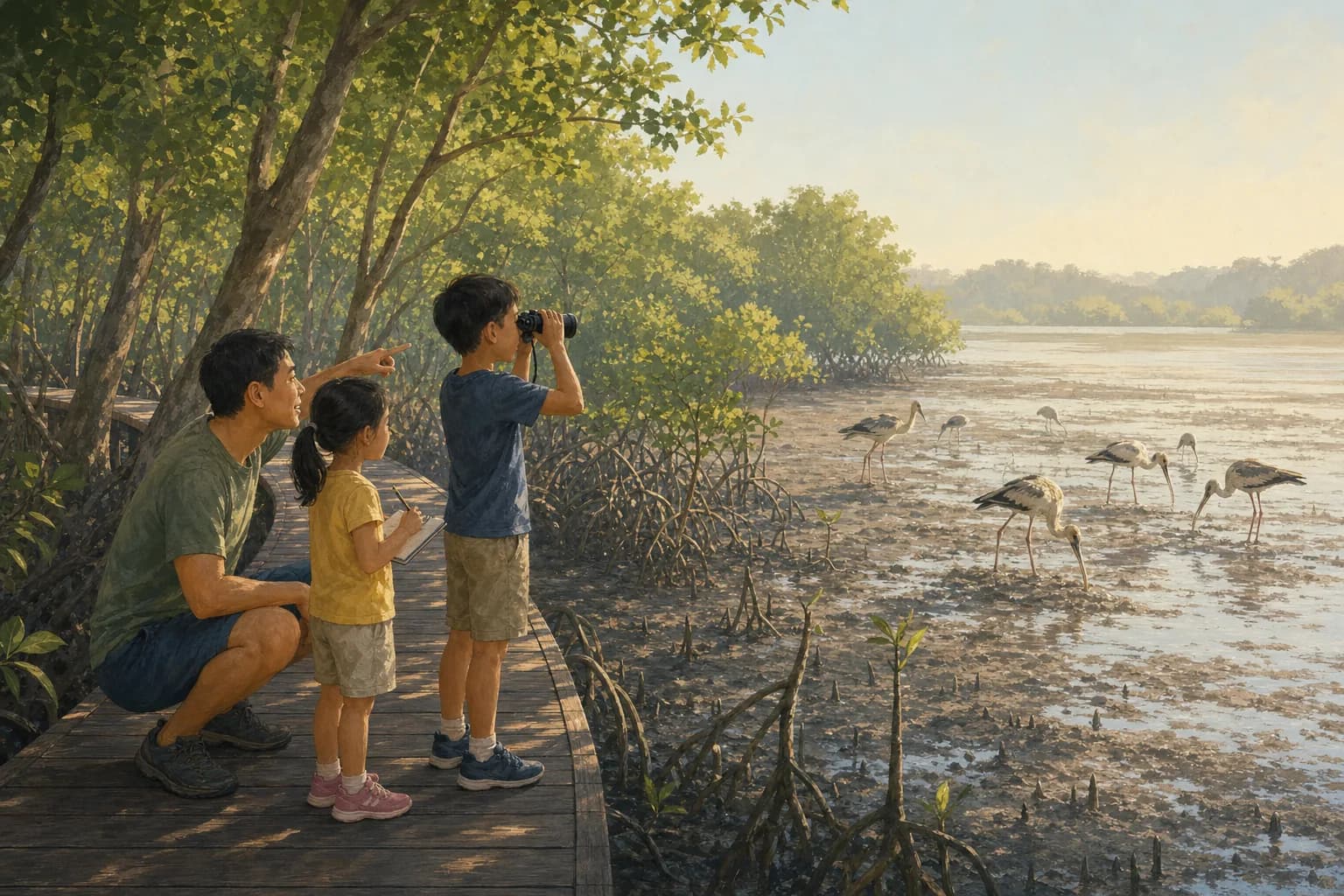
- Preschoolers: Mangrove Boardwalk, 500m. NParks says it brings you close to mudskippers, monitor lizards, crabs and spiders "without needing to get your feet wet or muddy". The longer loop is 3km.
- Lower primary: Coastal Trail, 1.3km, from freshwater ponds to mudflats and mangroves, past Eagle Point and the Kingfisher Pod.
- Keen spotters of any age: Migratory Bird Trail, 1.95km, with bird hides and shelters. NParks' birdwatching page for the reserve calls the trail around the Buloh Tidal Ponds the best place to see migratory birds.
- Older children: Aerie Tower, an 18m vantage point over the reserve. No page we read says whether it has a lift.
What can children spot in migratory season?
NParks says more than 200 bird species have been recorded at the reserve, and that it is part of the East Asian-Australasian Flyway, a route for birds that have flown from as far as the Arctic. Its history page adds that Sungei Buloh became Singapore's first ASEAN Heritage Park in 2003.
A spotting list for children, turned from NParks' own descriptions into clues:
- Whimbrel: a long bill that curves down, about twice the length of its head.
- Common Redshank: red legs and a straight bill; it washes its food before swallowing it.
- Common Greenshank: long yellowish-green legs; it sweeps its bill from side to side in the water.
- Pacific Golden Plover: short bill, golden brown feathers.
- Common Sandpiper: bobs its tail up and down at the water's edge.
- All year round: a Collared Kingfisher, whose call sounds like shrill laughter, and a White-bellied Sea Eagle, Singapore's largest raptor with a 2m wingspan.
NParks' general birdwatching page says birds are most active in the early morning, and asks visitors to keep quiet, give birds space and not play bird calls, rules worth agreeing before you set off.
Which free walks can families join?
NParks lists four kinds:
- Free guided tour in English: every Saturday, 9.30am to 11.30am, except public holidays and the eve of public holidays; up to 15 people; registration required through NParks' events listing.
- Themed walks for ages 5 and above: on 16 November the reserve's page listed "What's in my mangrove?" on Saturday 21 November and "What's in my water?" on Saturday 28 November, both 9.30am to 11am at the Visitor Centre. NParks' pages for the earlier runs, "What's in my mangrove?" (14 November) and "What's in my water?" (7 November), give the rules: register on site at the Visitor Centre information counter at least 15 minutes before; 15 places, first come, first served.
- Nature journaling workshop: "Windows into Nature & Heritage", run by the Friends of Sungei Buloh Wetland Reserve, on Saturday 21 November, 9am to 11am at the Visitor Centre, free, for children 5 and above with an adult. On 16 November the page still said it was full and offered a waitlist.
- Croc and Friends at Lookout Point: a volunteer stationed near the Wetland Centre for 90 minutes to talk about the crocodiles. It is listed as recurring, but the only date shown when we checked on 27 October and on 2, 9 and 16 November was Sunday 25 October (4pm to 5.30pm), already past, so check for the next one.
The tour, the walks and Croc and Friends may be cancelled in rain or bad weather.
How do you get there, and what are the rules?
- Address: Visitor Centre, 60 Kranji Way.
- By bus: from Kranji MRT station, bus 925 from Monday to Saturday or 925M on Sundays and public holidays, says NParks. We could not check timings with LTA.
- By car: free parking at the Visitor Centre (112 car lots) and the Wetland Centre (69).
- No weekly closing day is listed, unlike the places on our Monday closures page.
- Not allowed: pets, drones, fishing, music on speakers, and entering during bad weather.
- Wildlife: stay on the trails, keep your distance and do not feed or provoke animals. NParks' page on animal encounters says feeding wildlife is illegal, with fines of up to S$10,000; its Animal Response Centre is on 1800 476 1600.
Nearby, NParks' Kranji Marshes page lists a second stop at 11 Neo Tiew Lane 2, with free parking, also 7am to 7pm, where 8 of its 56.8 hectares are open to the public. Its 15m Raptor Tower, about 15 minutes from the visitor entrance, has steps only, and NParks says Black Bazas and Japanese Sparrowhawks pass through from November to March.
A half-day plan around the tide
This family is fictional; the times are NParks'. Farah and Daniel take their 9- and 5-year-old to the English tour on Saturday 26 December, when parts close from 11am to 2pm. They first check that the tour is listed for that day.
- 8am: arrive and walk the 500m Mangrove Boardwalk route with the 5-year-old; tick the spotting list.
- 9am: a look round the Junior Wetland near the Visitor Centre.
- 9.30am: the guided tour. The closure starts at 11am, half an hour before the tour ends; follow the guide and the signs.
- 11.30am: leave for lunch elsewhere, rather than waiting for the closed areas to reopen at 2pm.
The notices mark the affected areas in blue on a map we could not read, so on any listed date plan to finish before the time shown. If the weather turns, our Plan B guide helps you decide the fallback before you leave.
What to pack
From NParks: binoculars, a camera, insect repellent, comfortable clothes in darker greens or browns. Ours: water, hats and a pencil for the spotting list. For the rest of the break, see our year-end school holidays plan, or our MacRitchie guide for another nature reserve with short boardwalks.
Common questions
Is Sungei Buloh Wetland Reserve free?
NParks' trail and birdwatching pages say the walks and NParks' guided tours are free of charge, and parking at both carparks is free.
What are Sungei Buloh's opening hours?
7am to 7pm, with last entry at 6.30pm; NParks lists no weekly closing day, but some areas close at high tide on dates it publishes.
When is the best time to see migratory birds at Sungei Buloh?
Between August and April, on the Migratory Bird Trail around the Buloh Tidal Ponds, and NParks says birds are most active in the early morning.
Is Sungei Buloh closed in December 2026?
NParks lists no full closure, but parts close for high tide on 25 December (10am to 1pm), 26 December (11am to 2pm) and 27 December (12pm to 3pm), and some areas may flood, and may close, on 24 and 28 December.
Sources
- Sungei Buloh page nparks.gov.sg
- closure notice nparks.gov.sg
- flood-risk notice nparks.gov.sg
- 2026 school calendar moe.gov.sg
- trails and tours page nparks.gov.sg
- birdwatching page for the reserve nparks.gov.sg
- history page nparks.gov.sg
- birdwatching page nparks.gov.sg
- What's in my mangrove? nparks.gov.sg
- What's in my water? nparks.gov.sg
- Windows into Nature & Heritage nparks.gov.sg
- Croc and Friends at Lookout Point nparks.gov.sg
- page on animal encounters nparks.gov.sg
- Kranji Marshes page nparks.gov.sg
Something changed or worth adding?
Send a correction or suggestion

